European Reference Networks (ERNs) are building Europe’s Rare Disease Ecosystem: 3 days of debate, 8 priorities, one shared Declaration, 30 million people living with a rare disease in Europe.
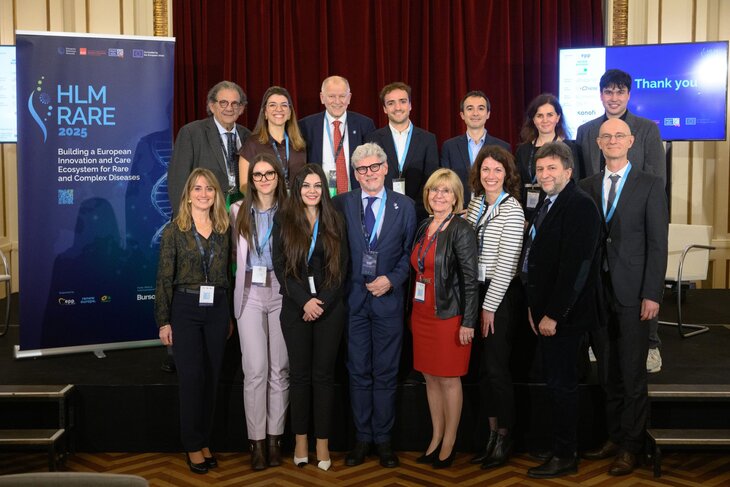
The High-Level Meeting (HLM) on a European research and innovation ecosystem for rare diseases was held in Brussels from 9 to 11 December 2025.
Hosted by the European Reference Networks (ERNs), Member of the European Parliament Vytenis Andriukaitis (S&D, Lithuania) and the Brains for Brain Foundation, the HLM brought together EU policymakers, industry representatives, researchers, healthcare professionals, and patient organizations to define concrete actions towards the new European frame in the rare disease field.
Over three days, discussions focused on: Day 1, centered on research and innovation: how Europe can regain leadership in rare disease science by supporting clinical trials, translational research, and an ambitious Research and Innovation Union. Day 2, infrastructure and skills: strengthening the ERNs and EU capacity, including newborn screening, data spaces, and the use of artificial intelligence to shorten the diagnostic journey. Day 3 focused on policy and funding and how these can accelerate to turn innovation and infrastructure into timely, equitable access to care and treatments for all people living with rare and complex diseases across Europe.
Dr. María del Mar Mañú Pereira, ERN-EuroBloodNet scientific coordinator and ENROL European registry coordinator, was part of the HLM organizing team. In addition, she played an active role in the program by moderating Day 2 and contributing to the Day 2 panel discussion, where important topics and EU legislations regarding Health data and the use of AI were discussed.
%20(18).png) Dr. María del Mar Mañú Pereira moderating and contribuiting on Day 2.
Dr. María del Mar Mañú Pereira moderating and contribuiting on Day 2.
A key outcome of the High-Level Meeting was the launch of The Declaration on the European Innovation and Care Ecosystem for Rare and Complex Diseases. This declaration aims to pave the way towards the future actions needed to address the unmet needs of more than 30-36 million patients in the EU. And examines how to strategically place research and innovation at the heart of EU life science and Health policy, using rare diseases as a model to showcase the EU's added value.
The Declaration was signed on site by the ERNs Coordinators, some members of the European Parliament, Patients Organizations, Professional Societies & Research institutes/organizations/projects and it aims at gathering as many signatures of support as possible.
The Declaration outlines eight priority topics aimed at strengthening the rare disease research and innovation ecosystem, which are set out within its Roadmap for Priority Action. To advance these priorities, dedicated Working Groups will be established. Among them, the data-focused Working Group will be led by Dr. María del Mar Mañú Pereira, Scientific Coordinator of ERN-EuroBloodNet.
%20(19).png) In the images above: Alexis Arzimanoglou, Maurizio Scarpa, Ruth Ladenstein, Dr. María del Mar Mañú Pereira & Vytenis Andriukaitis.
In the images above: Alexis Arzimanoglou, Maurizio Scarpa, Ruth Ladenstein, Dr. María del Mar Mañú Pereira & Vytenis Andriukaitis.
The Declaration is a political and strategic commitment to fundamentally transform our ecosystem. It sets out a bold shared vision, clear strategic priorities, and a roadmap that includes, in the short term, the establishment of a Consultative Group to develop a concrete, measurable Action Plan, and in the medium to long term, accelerated progress for rare and complex diseases-through more treatments, universalized newborn screening, and advanced diagnostics.
%20(20).png) High Level Meeting (HLM)
High Level Meeting (HLM)