
Rare Disease Day 2026: Yunu's story
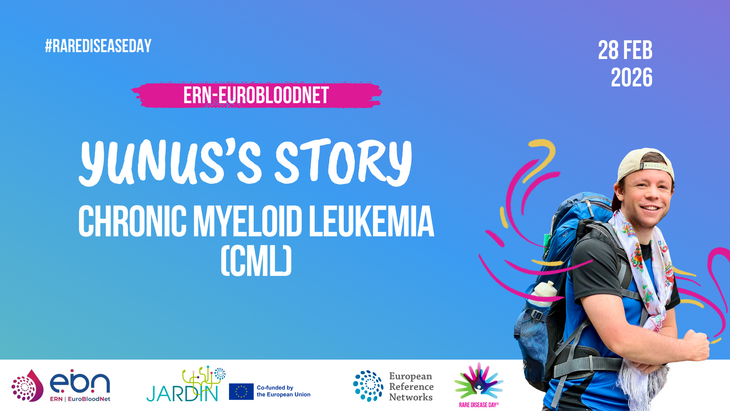
At the age of 12, Yunus was diagnosed with Chronic Myeloid Leukemia (CML).
In the context of Rare Disease Day 2026, the JARDIN Joint Action highlighted the stories of patients from the 24 European Reference Networks (ERNs). One of these stories is that of Yunus, who was diagnosed with Chronic Myeloid Leukemia (CML) at the age of 12. The diagnosis was a shock for him and his family. "I was still a child. I often asked myself why it had happened to me" he recalls. In Germany, around 15 to 20 patients under 18 are diagnosed with CML each year, approximately 0.7 per 1,000,000.
From ERN‑EuroBloodNet, we would like to sincerely thank Yunus for sharing his story with us and for his dedication to patient advocacy!
“My name is Yunus, I am 25 years old and come from Albstadt, a small town in southern Germany.
Thirteen years ago, not only my life but also the lives of my entire family and circle of friends were turned upside down. On January 25th, 2013, at the age of 12, I was diagnosed with chronic myeloid leukemia. It was a shock for all of us. To me, cancer had always been something that only old people get. I was still a child. At that time, I often asked myself why it had happened to me of all people. What had I done wrong? Was I going to die? And what would my life - and the lives of my family - look like from now on?
Shortly after my diagnosis, the doctors told me in the hospital that chronic myeloid leukemia is a disease that usually only affects older people. In Germany, around 15 to 20 patients under the age of 18 are diagnosed each year. That equals about 0.7 per 1,000,000. In short: I had won the lottery.
They also said that I didn't need to worry too much. There are medications that cannot cure CML, but can keep the disease under control. That is why CML is sometimes referred to as "the lucky cancer." Personally, I really dislike this term. On the one hand, I believe that no cancer diagnosis is ever "lucky." On the other hand, reality looks very different.
I am incredibly grateful for these medications. Before they were developed, CML was a fatal disease. They also allow me to live my life and do what I want every day. However, these drugs come with many side effects. With the first medication I took during the first six months after my diagnosis, I sometimes experienced such severe muscle and bone pain in my legs that I would simply collapse. With the second medication, which I took for over ten years, I suffered from extreme fatigue and red spots on my skin, similar to goosebumps. Because of that, many people asked me if I was cold. Often, I had no choice but to explain that my illness and its treatment were the reason.
I feel these side effects every single day. I see them every time I look in the mirror. By now, I have been taking these pills for so long that I have forgotten what it feels like to live without side effects.
Early on in my journey as a patient, I made a promise to myself: no matter what happens, I will never give up or let my illness win. Whatever I do, I want to give my best and never give up my dreams because of a disease. Nothing motivates me more than the idea of being just as good as a healthy person - if not even better. And that is exactly how I want to live every single day.
Back then in the hospital, I had one wish: I really wanted to meet other children and young adults with my condition, to see how they cope with the disease and its side effects. But there was a problem: during the six years I was treated in pediatric care, I was the only CML patient. There simply were no others - except for older patients. And unfortunately, that is how I was treated at first as well.
I don't blame anyone for that, because there was simply a lack of experience with children. But it is obvious that young patients have a very different understanding of quality of life and completely different needs than older people. In the end, this is what led me to follow in my mother's footsteps and also get involved in patient advocacy.
And that is exactly what equality means to me: on the one hand, changing how young patients are perceived, giving them a voice, and showing that even though we are a minority, we deserve to be heard just as much. That our wishes must be taken into account in future therapy development. On the other hand, equality means that we deserve a life with cancer that looks just like our life before. That we have the same opportunities as healthy people. And that our quality of life does not decrease.
Despite illness and treatment, our lives should continue just as they did before. And I will never stop standing up for that. I will keep fighting within my means so that one day it feels like we are in control of our lives - and not the disease. We have already come a long way. But we still have a long road ahead of us. And I will not give up. No matter what.”